From Roman glory to modern coastal charm
Pula is one of those cities where history doesn’t sit quietly in museums — it’s right there in the streets, the squares, and even the beach views. Located at the southern tip of the Istrian peninsula in Croatia, Pula has been shaped by thousands of years of different cultures, rulers, and empires. Let’s take a relaxed walk through its story.
Ancient Beginnings: Before the Romans
Long before Pula became famous, people were already living here. The area was settled by the Histri, an ancient Illyrian tribe, as early as the Bronze Age. They chose the spot for a good reason: it had a protected natural harbor and access to the sea.
These early inhabitants left behind hill forts and traces of everyday life, but Pula’s real transformation was still to come.
Roman Pula: The City Takes Shape
Pula truly entered history during Roman times, starting around the 1st century BC. The Romans recognized the strategic value of the location and turned it into an important regional center.
This is when Pula gained its most iconic landmark:
🏛️ The Arena of Pula
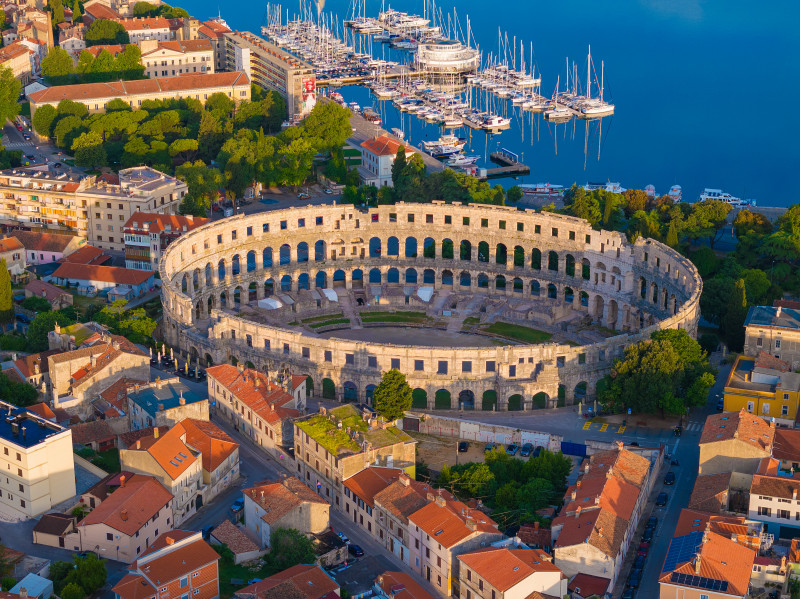
Built in the 1st century AD, the Arena is one of the best-preserved Roman amphitheaters in the world. Gladiator fights were once held here, drawing crowds from across the region.
Other Roman highlights still visible today include:
-
The Temple of Augustus
-
The Arch of the Sergii
-
Remains of Roman streets, walls, and mosaics
By the height of the Roman Empire, Pula was a busy, elegant city with forums, baths, and thriving trade.
After Rome: Turbulent Centuries
When the Roman Empire began to decline, Pula entered a long and difficult period. Over the next several centuries, it was ruled by many powers, including:
-
Byzantines
-
Franks
-
Venetians
Wars, invasions, and outbreaks of disease caused the population to shrink dramatically. At times, Pula was nearly abandoned. Still, the city survived, adapting again and again.
Venetian and Austro-Hungarian Rule
From the 14th century, Pula became part of the Venetian Republic, which left its mark on architecture and culture. However, the city remained relatively small and quiet during this period.
Everything changed in the 19th century under the Austro-Hungarian Empire. Pula was transformed into a major naval port, bringing:
-
Rapid population growth
-
New buildings, forts, and infrastructure
-
A mix of cultures, languages, and traditions
Many of the elegant buildings you see today come from this era.
The 20th Century: Change and Identity
The 20th century brought big shifts. After World War I, Pula became part of Italy, and after World War II, it was incorporated into Yugoslavia. These transitions led to major population changes, as many residents left and new communities arrived.
When Croatia became independent in 1991, Pula once again found itself redefining its identity — this time as a Croatian city with a rich, multicultural past.
Pula Today: History Meets the Sea
Today, Pula is a lively coastal city where ancient ruins sit comfortably alongside cafés, festivals, and beaches. The Arena hosts concerts and film festivals, Roman temples frame everyday city life, and the harbor remains central to the city’s character.
Pula’s story isn’t just about empires — it’s about resilience, reinvention, and living history.
Why Pula’s History Feels So Special
What makes Pula unique is how visible its past is. You don’t need a guidebook to feel it — just take a walk. From Roman stonework to Austro-Hungarian streets and modern Croatian culture, Pula tells its story openly, one layer at a time.
If you love places where history feels real, not distant, Pula is a city that quietly impresses.